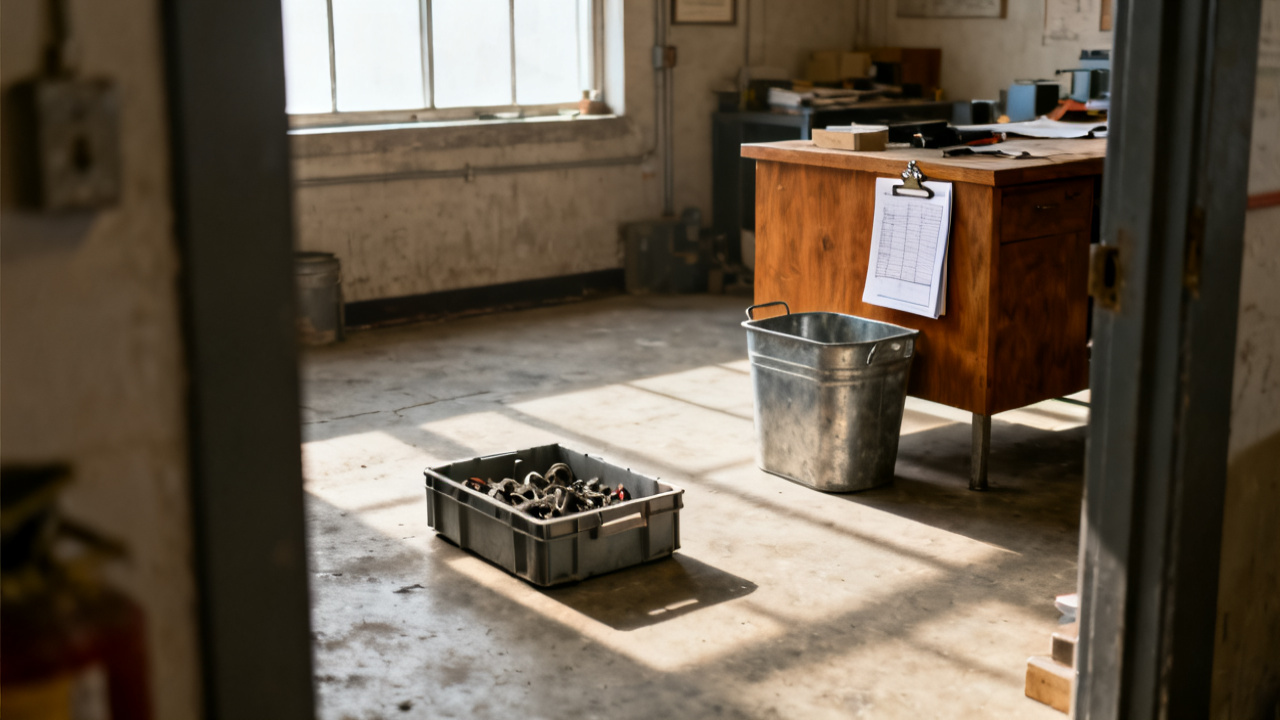
Someone wrote hold on the face. The parts are still at the machine. You spot the scrawled red marker halfway across the top right corner as you reach for the sheet to log your completed milling pass, and you pull your hand back before your fingers make contact. The 4140 billets you set up 20 minutes prior are still clamped in the vise, spindle parked an inch above the first roughing cut path you programmed. No one is standing near your bench to explain the note, so you set down your end mill organizer and pull the sheet toward you to scan for context.
Context clues you pull from this traveler first
You start by scanning for the date and time next to the hold note, plus the initials of the person who wrote it, to narrow down who you need to speak to for clarification. You cross-reference the part number printed at the top of the traveler with the number etched into the side of each billet in your vise, to confirm the hold applies to the batch you have set up, not a different run on another machine. You flip through the preceding operation sign-offs to see if any dimensional checks were flagged after the lathe work or heat treatment, as those are the most common triggers for unplanned hold calls. If no comments are listed next to the hold, you check the back of the sheet for tucked-in notes referencing engineering change orders, material lot discrepancies, or requests to pause production while the design team adjusts fit tolerances for the final assembly.

Details you confirm with the shift lead before touching clamped parts
You do not unclamp the parts or adjust the vise alignment before you track down the team member whose initials are on the hold, as any shift to the setup could force full rework if the hold is temporary and you are cleared to resume cuts immediately. You ask three core questions to get full context: first, whether the hold applies only to this batch of 12 parts or the full 120-part run scheduled for the week, second, whether you need to preserve the current setup for a third-party quality audit, and third, what the expected turnaround time for resolution is so you can plan the rest of your shift accordingly. If the shift lead does not have answers to these questions immediately, they connect you to the quality engineer assigned to the job, who walks you through the exact concern that triggered the hold. You jot all answers down in pencil in the left margin of the traveler, so you have a record of the conversation if another operator picks up the job while you are assigned to other work.
Adjustments you log on this traveler as soon as resolution comes through
Once you get formal clearance to resume work, rework existing parts, or scrap the full batch, you log every relevant detail directly on the traveler so everyone who accesses the sheet later has full, unfiltered context for the pause. All entries are written in blue permanent marker to stand out from the original black printed text and the red hold note, and you initial each entry to confirm you were the one who logged the updates.
| Field | Entry Requirement | Example Entry |
|---|---|---|
| Hold resolution sign-off | Must include full name, employee ID, and date/time of formal clearance | J. Marquez, ID 472, 10:17 AM 10/12/24 |
| Revised operation parameters | Must list any changes to feeds, speeds, cut depth, or tooling from the original job specification | Illustrative example: Feed rate reduced from 12 IPM to 9 IPM, 3/8” carbide end mill swapped for TiN-coated variant to reduce chatter on thin side walls |
| Pending next steps | Must specify any required checks before the next operation begins | First 2 parts from resumed run require full dimensional inspection by quality team before remaining 10 parts are milled |
You draw a single thin line through the original red hold note once you are cleared to move forward, so anyone glancing at the sheet immediately sees the hold is no longer active, and you avoid scribbling over the note entirely so the original mark remains visible for audit trails.
Actions you take to flag this traveler for follow-up before you move to another task
If the hold is expected to last more than two hours, you do not leave the sheet tucked under the vise or mixed in with other completed job paperwork. You first place a bright green flag sticker on the top right corner next to the hold note, so the traveler is easy to spot in a stack of other job documents. If you are reassigned to a different job while the hold is pending, you leave the traveler on the Traveler Desk right by the shop floor entrance, with a sticky note on the front listing your name, the machine the parts are parked at, and the contact information for the team member handling the hold resolution. You do not move the clamped parts from your machine unless you get explicit direction to do so, and you leave a handwritten note taped to the spindle of your mill noting that the parts in the vise are on hold, with the job number and traveler ID listed clearly so no one else sets up a new job on top of your existing alignment before the hold is resolved.
Checks you run when you revisit this traveler mid-shift
When you come back to the sheet to check on the hold status or resume work, you first confirm no new notes have been added since you last looked at it, either on the front or back of the document. You cross-reference the resolution sign-off on the traveler with the information you jotted down in the margin earlier, to make sure the clearance matches the parameters you discussed with the shift lead. You verify that any revised operation parameters you logged are correctly entered into your mill’s control panel before you start any cuts, running a test pass on a piece of scrap material first to confirm the settings produce the expected surface finish and dimensional accuracy. You check that the part number on the traveler still matches the parts in your vise, to make sure no one swapped out the batch while you were working on another job. If you find any new notes or discrepancies between the traveler and your setup, you pause immediately and reach out to the shift lead before making any changes, to avoid introducing errors that could lead to scrap or rework. You also log your return to the job on the traveler, including the time you start the first cut after the hold is lifted, so the production tracking team has an accurate record of how long the hold delayed the run, and can adjust scheduling for future jobs that use the same machine. You take two minutes to cross-check all sign-offs on the sheet once you finish the first two parts for quality inspection, to make sure you did not miss any additional requirements added to the traveler while you were working on other tasks.